4 min read

VoicePlug’s conversational AI now integrated with Qu to enable intuitive voice ordering across phones and drive-thrus.Palo Alto, CA…
Learn More
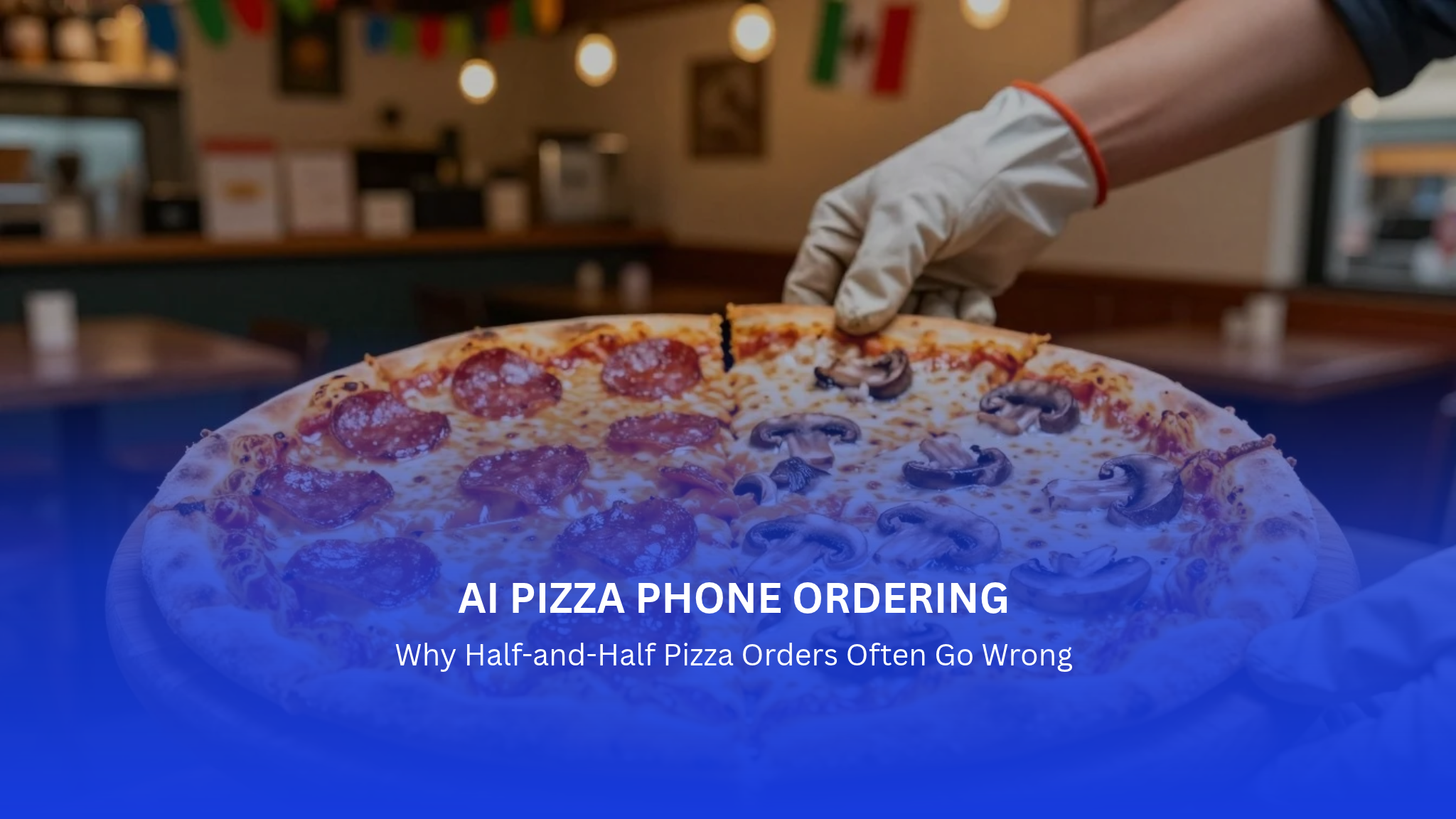
Half-and-half orders go wrong when a topping gets recorded without a clear link to the side it belongs on. Generic phone ordering tools often lose that link between a caller’s words and the kitchen ticket, even when every ingredient sounds clear on the call.
A caller might ask for one large pizza with pepperoni on one half and mushrooms on the other. During a busy lunch rush or a Friday dinner spike, callers already deal with hold times or busy signals, and an automated system still has to capture every modifier cleanly before firing the order. A modifier is any detail that changes an item, such as a topping, crust style, or bake instruction. A reliable order flow, like the one built into AI Pizza Voice by VOICEplug AI, has to preserve the whole pizza and lock each topping to its proper half.
Purpose-built voice systems can take pressure off counter staff during a lunch rush or handle phone orders after hours when a smaller crew is closing the store. Because PizzaVOICE is engineered specifically for pizzerias rather than general retail, it treats split pizzas, build-your-own pies, sizes, and coupons as structured restaurant orders rather than loose blocks of text. Still, accurate phone ordering depends on more than answering the ring. The main risk on a split pizza is not missing a topping completely, it is putting the right topping on the wrong side and forcing a remake.
A caller can name every topping clearly and still leave the order ambiguous if the sides are not attached. Half-and-half describes two topping zones on one pizza, but casual speech often leaves out which zone gets which ingredient.
Each topping needs a clear side assignment before the order is ready for the make-line. “Pepperoni on one half” and “pepperoni on both halves” sound similar on a fast call, yet they build two completely different pizzas.
Treat each side as a separate part of the order, not as a guess based on the order the caller spoke.
Four common habits make half-and-half pizza orders hard to capture accurately:
A related mistake happens when a system treats a topping mentioned once as an instruction for the whole pizza. The caller meant half pepperoni, but a flat order list turns it into a whole-pizza topping. Repeating the topping name back to the caller does not solve the problem if the side stays missing.
That distinction matters even when a call sounds simple. One large half-and-half pizza has two separate topping zones, whereas a standard pie carries one topping across the whole crust. Never assume a topping belongs on both sides just because the caller named it once. Keep each side explicit in the order record.
“Half” can mean two topping zones on one pizza, or it can describe a single topping placed on only one side. Checking the number of pizzas first shows which meaning fits the caller’s request.
A shop can hear “half sausage” on a noisy line and need one quick check before knowing whether the caller wants a split specialty pie or a single topping zone. Confirm the pizza count before interpreting an unclear use of “half.”
A single pizza with two topping zones is the standard meaning of a half-and-half pizza. One large pizza might have pepperoni on one half and sausage on the other. On the ticket, that is one item with two different topping assignments, not two separate pizzas.
Callers rarely speak in ticket order, so the system cannot rely on which topping came first. If a caller says “pepperoni and sausage, half and half,” the order record still needs to show which topping goes on each side so the make-line builds it right the first time. For repeat callers, PizzaVOICE’s customer preference and order memory can also recall past favorites and dietary choices, making it faster to confirm a familiar split build without unnecessary back-and-forth.
Two separate pizzas are two whole items, even if a caller uses the word “half” while describing one of them. A caller might want two pizzas with half pepperoni on one of them, or one pizza with pepperoni on one half. Those requests require different item counts and different pricing.
Asking whether the caller means one pizza or two prevents bad tickets when the count is unclear. Another common case happens when a caller orders toppings on both sides and then changes only one half. The edited side has to update cleanly while the other side stays as originally ordered.
Your order flow also has to separate “one topping on half a cheese pizza” from “two toppings split across one pizza.” Confirming the item count up front keeps a single split request from turning into two miscounted pizzas.
A call transcript can capture every word accurately while losing the only detail that matters on the make-line: which topping belongs on which half. High speech-recognition scores only show that the software heard the words, not that it built a complete ticket.
Real restaurant calls are rarely quiet. Callers order from loud cars, crowded offices during the lunch rush, or windy sidewalks while your own ovens, phones, and drive-thru queues hum in the background. Callers also speak in different languages and regional dialects, and similar-sounding toppings, like bacon and basil, or ham and lamb, can blur together when someone talks fast.
A correction can get dropped if the caller says it after the system has already moved to the next prompt. Speech tools can skip short prepositions, so capturing a topping name does not guarantee the side assignment was captured with it. A clean-looking transcript still produces a bad pizza if it attaches a topping to the wrong side.
Standard phone line compression is designed to carry basic human speech, not to guarantee that automated software separates every modifier cleanly. Even on a clear connection, the ordering logic has to bind item, topping, and side together.
An AI phone answering system can produce a readable log while missing one small word that changes the build. If the caller says “mushrooms on the left” and the system records only “mushrooms,” the words look fine while the kitchen ends up making a whole mushroom pizza.
That is why VOICEplug’s PizzaVOICE supports multiple languages and dialects while separating missing side assignments from speech transcription. When a side assignment is unclear, the system treats it as an open detail to clarify with the caller, or pass to staff, rather than guessing.
A reliable order flow locks in the base pizza first, then attaches each topping to a named side. Structured fields keep those details together instead of dumping toppings into a flat text list.
Keep every modifier attached to the exact pizza and zone it changes. A clean record shows one pizza, two distinct sides, and a clear topping assignment for each side.
An automated phone system should store every pizza across five structured fields:
Each field stays tied to that single pizza. On a multi-pizza order, the system should never mix a topping from the first pie with a side on the second. PizzaVOICE uses this item-level structure across half-and-half pies, build-your-own pizzas, combo modifications, and coupon redemptions so complex phone orders stay readable from call start to ticket print.
Suppose a caller asks for extra cheese on the whole pizza and mushrooms on one half. The order should store extra cheese as a whole-pizza modifier and place mushrooms only on the named side, leaving the other half untouched.
A substitution should only change the specified side. If the caller removes pepperoni from one half, pepperoni should stay on the other half. Editing one side should never wipe out or alter the second side.
This structure also makes it easier to review modifiers before firing the ticket. When a caller changes a topping or crust mid-call, updating the matching field keeps the rest of the order intact instead of rebuilding the pizza from a messy string of old and new words.
Even when the phone conversation goes smoothly, the kitchen ticket can only preserve a half-specific detail if your POS supports it at the right level. Your point-of-sale system controls how menu items and modifiers map to the kitchen printer or KDS.
A POS modifier is an instruction tied to a menu item. If a topping is not configured for half-pizza scoping in your POS, the side label gets stripped before the ticket prints.
If your POS only offers a topping as a whole-pizza modifier, it cannot store a half-specific assignment. The phone system needs a valid POS modifier path to attach that topping to one side of the pie. Menu architecture directly controls what reaches the make-line.
Substitutions, coupons, and upcharges follow the same rule. If the caller asks for extra cheese on one half, the POS needs to keep that scope instead of applying it to the whole pizza. Half-topping pricing depends on your POS setup, and the caller needs to hear the accurate price before paying.
The kitchen ticket has to show the difference between extra cheese on the whole pizza and extra cheese on one half. During a rush, line cooks read tickets in seconds and should not have to guess what an abbreviated modifier means.
A common failure happens when a voice tool captures the right order, but the printed kitchen ticket drops the side label. Line staff see “extra cheese” and spread it across the entire pizza.
PizzaVOICE is built for compatibility across major pizza POS systems and online ordering workflows, routing confirmed orders directly to the POS as structured tickets so half-specific modifiers reach the kitchen intact. Even so, operators should always check both the stored voice order and the actual ticket printing on the make-line during setup.
A read-back only prevents remakes when it states which topping belongs on which side. Naming the sides gives the caller a chance to catch a wrong assignment before the ticket hits the kitchen printer.
Repeat the pizza size and crust, both topping sides, and any whole-pizza modifiers in one clear summary. Once the core split pizza is accurate, the system can also handle contextual upselling, such as suggesting drinks, sides, or dipping sauces, without muddying the pizza build itself.
For example, PizzaVOICE can confirm one large thin crust pizza, pepperoni on one half, mushrooms on the other, and extra cheese on the whole pizza. Naming the base pizza first anchors the rest of the details.
A specialty order like a large margherita with half pepperoni needs the same care. “Large half pepperoni” covers the size and one topping, but the other half and the crust choice still need explicit confirmation. Never treat a quick “yeah” as approval for details that were never repeated.
If only one side assignment is missing, the system should ask about that specific topping and wait for the answer. Once the caller clarifies, it should read back the complete pizza once with the correction included. That keeps a small question from turning into a full restart.
Strong rollout management relies on clear ownership, regular call reviews, tracking ticket error rates, and fixing broken prompts quickly. None of those processes replace a plain spoken confirmation on the call. A caller’s “yes” to half a summary does not confirm unstated details.
If you want to see how structured read-backs and half-and-half prompts sound in practice, you can experience PizzaVOICE directly on VOICEplug’s product page.
During a Friday or Saturday dinner rush, or a packed weekday lunch rush, one unclear side assignment slows down the entire counter. Callers are in a hurry, and the kitchen has no room for remakes.
When phone lines back up, callers abandon calls or tie up staff with repeated questions. Four pressure points make phone orders harder to manage during peak hours:
Shops running both phone lines and drive-thru queues feel this bottleneck immediately, because an employee wearing a drive-thru headset cannot easily pause window service to untangle a complicated split pizza on the phone. Phone orders after hours or right before closing create a different strain, where a smaller closing crew has to absorb every call and a single remade pizza delays shutdown. With 24/7 availability, PizzaVOICE absorbs incoming phone orders around the clock so counter and drive-thru teams can stay focused on in-store guests and oven flow.
A short, direct question fixes a missing side without restarting the order. A caller who says “mushrooms on one half” only needs to name that half, not repeat the size, crust, and other topping.
When a call does need to transfer to the counter, passing along the details already collected keeps the handoff fast. Making a caller repeat their name and first two pizzas to a busy cashier defeats the purpose of answering the call early.
The operational rule is simple: clarify when a standard order detail is missing, and hand off to staff when the question requires store-level judgment.
Never guess on a missing topping or a food safety question. Ask one focused question for missing order data, and route the call to the store when the system cannot verify an answer.
If the caller has not given a pizza count, ask whether the order is for one pizza or two. If they name a topping without a side, ask which half gets it. If a substitution is unclear, ask which topping is being replaced.
Keep follow-up questions focused on the single missing detail so the caller never has to repeat information the system already locked in.
Allergy and ingredient questions require accurate, store-specific answers from trained staff. While food safety guidelines recognize nine major allergens, a “gluten-free crust” option on a menu does not tell a caller whether shared ovens and flour dust make the kitchen unsafe for someone with celiac disease.
A human handoff is the right move even when the speech recognition worked perfectly. Hearing the question accurately is not the same as having authority to guarantee safe kitchen preparation.
Never collect payment before the order is confirmed. Charging a card before confirming both halves and any modifier upcharges creates refund headaches at the register.
If the system cannot confirm an ingredient or prep method, it should say so plainly and transfer the caller to the team.
Do not judge a voice ordering setup by reading call transcripts alone. Judge it by whether the ticket printing on the make-line matches what the caller actually asked for.
Track side-assignment errors separately from speech-recognition errors. A clean transcript that prints pepperoni on the wrong half is still a failed order.
A practical pre-launch test set should include at least one example of each scenario:
Compare the caller’s audio against the transcript, then check the structured order fields, the spoken read-back, and the printed kitchen ticket. Tracing all four steps shows you the exact point where a side label disappeared.
Assign clear ownership on your team, working alongside your implementation partner, to review test calls, measure ticket accuracy, and tune menu mappings before peak shifts. Structured quality checks keep the rollout accountable, but nothing replaces sending real test orders through to your kitchen printer.
Include messy calls during onboarding, background noise, interruptions, and mid-call edits, rather than only slow, scripted test calls. Verify that removing a topping from one half leaves the other side unchanged.
Whenever you update POS modifiers, coupons, or seasonal items, run a fresh half-and-half test order. A small change in your POS menu can quietly break side labels on the kitchen ticket.
Your make-line crew needs a consistent format for split pizzas so they never have to stop and guess during a rush.
Every split kitchen ticket needs clear pizza counts, size, crust, and side-labeled toppings. During staff onboarding, compare a properly labeled split ticket with an unlabeled one so line cooks know what to watch for.
Have staff flag any ticket missing a side label and report recurring modifier mismatches right away. When a call transfers to the counter, staff should see or hear what was already captured and ask only for the unresolved detail.
Avoid relying on “left” and “right” alone on kitchen tickets. A customer pictures a pizza from one angle, while a cook stretching dough on the make-line views it from another. Pairing each topping directly with its half label, such as “Half 1: Pepperoni” and “Half 2: Mushrooms”, removes the guesswork.
Print each topping with its half label on the kitchen ticket rather than relying on orientation alone.
Train shift leads to note whether an error came from a caller’s phrasing or a recurring POS formatting issue.
When reporting a problem, ask staff to flag the exact ticket field that failed rather than saying the whole call went wrong. Specific ticket feedback is much faster to fix.
Accurate half-and-half orders depend on keeping each topping tied to its side from the caller’s first words all the way to the kitchen ticket. Phone automation only helps a busy pizza shop when complex builds are structured, confirmed, and mapped cleanly into the POS before the order fires.
VOICEplug built PizzaVOICE around those exact pizzeria realities, handling half-and-half configurations, build-your-own pizzas, coupons, multilingual callers, 24/7 call coverage, and structured POS ticket routing without forcing counter staff to babysit the phone. Every topping still needs an explicit side assignment, and every split pizza still needs a complete read-back before submission.
If you want to evaluate how your current workflow handles split pies, pull one recent half-and-half ticket alongside its call recording, check that each topping stayed attached to the intended half, and schedule a PizzaVOICE demo to see how structured pizza voice ordering fits into your kitchen operation.
1. Can a caller ask for the same topping on both halves?
Yes, a caller can request the same topping on both halves, as long as the order records it clearly. The ticket can list the topping on each side or mark it as a whole-pizza modifier so the make-line knows it covers the entire pie rather than just one half.
2. What should a caller say to make a half-and-half order clearer?
State the pizza count first, name each topping with its half, and finish with whole-pizza modifiers. For example, saying “one large pizza, pepperoni on one half, mushrooms on the other, and extra cheese on the whole pizza” leaves no room for the system to guess the layout.
3. Can an AI phone agent handle a mid-call topping change?
Yes. A specialized pizza ordering system like PizzaVOICE handles mid-call topping changes by updating only the specified half in its structured order fields and reading back the revised pizza. Removing a topping from one side leaves the same topping intact on the other side, and the caller confirms the updated pie before submission.
4. Is a gluten-free pizza automatically safe for someone with celiac disease?
No, a gluten-free crust option is not automatically safe for someone with celiac disease. Callers need to ask the store directly about ingredients and cross-contact in shared ovens and prep areas, and the phone system should transfer those questions to staff rather than guessing.
5. Should a restaurant collect payment before confirming a half-and-half order?
No, the restaurant should confirm the full pizza, both halves, and any modifier upcharges before taking payment. Collecting payment early does not fix a missing side assignment, and a final confirmation gives the caller a chance to catch mistakes before the ticket prints in the kitchen.
6. What should staff check when the caller’s transcript looks right but the kitchen ticket is wrong?
Compare the structured order fields with the printed kitchen ticket, paying close attention to each topping’s side label. A transcript can capture the right topping names while a POS modifier mapping drops or alters the half assignment between order capture and ticket printing.

Jay Ruparel is a serial tech entrepreneur with a proven track record in building and scaling global technology-driven businesses. As the Co-Founder and CEO of VoicePlug Inc., he leverages his expertise in AI, machine learning, and digital transformation to drive innovation and growth. Jay is also the Co-Founder of Azure Knowledge Corporation and has received the EY Entrepreneur of the Year award. Outside of his professional endeavors, Jay mentors startups and serves as an advisor to various organizations.


VoicePlug’s conversational AI now integrated with Qu to enable intuitive voice ordering across phones and drive-thrus.Palo Alto, CA…
Learn More
Both are “conversational AI.” Both promise to answer guest questions around the clock. Vendors often pitch them as…
Learn More
Every restaurant tech vendor now says it is “AI-powered.” Every trade show booth promises to cut labor, grow…
Learn More
An AI phone call assistant for restaurants is voice AI that answers every incoming call, takes the full…
Learn More